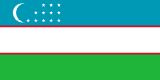
Uzbekistan

Turkic
Uzbekistan flag
Languages
Native
Uzbek
85%
Secondary languages
Russian
15%
Tajik
11%
Language Samples
Salom, qandaysiz?
Hello, how are you?
Yaxshiman, rahmat.
I am well, thank you.
Bir, ikki, uch, to'rt, besh, olti, yetti, sakkiz, to'qqiz, o'n.
One, two, three, four, five, six, seven, eight, nine, ten.
Linguistic History

Uzbek is a Karluk Turkic language and the most widely spoken language in Central Asia, with roughly 35 million native speakers. It has the longest literary tradition of any Turkic language, built on the rich Classical Chagatai heritage — the prestige literary language of the Timurid and Mughal courts, in which the poet Alisher Navoi wrote masterpieces in the 15th century. Like other Soviet Central Asian languages, Uzbek was first given a Latin alphabet in 1929, then switched to Cyrillic in 1940. After independence in 1991, Uzbekistan adopted a new Latin-based alphabet, which became fully official in 1993 and is now used in all schools, official documents, and media. The Cyrillic version persists informally among older generations. Uzbek's Karluk branch sets it apart from the Kipchak languages of Kazakhstan and Kyrgyzstan, giving it closer lexical ties to Uyghur and Chagatai.

Similar Languages
Kazakh
72%
Turkish
73%
Uyghur
76%
Kyrgyz
70%
Media
The Registan in Samarkand — the medieval heart of Timurid civilisation and a UNESCO World Heritage Site where Chagatai Turkic, the literary ancestor of Uzbek, flourished.
Photo: Euyasik · CC BY-SA 3.0
Did You Know
01
Classical Chagatai Uzbek literature predates most European national literary traditions — Alisher Navoi's 15th-century Khamsa epic cycle is still studied in Uzbek schools today.
02
Uzbek uses vowel letters o' and g' with apostrophes in the modern Latin script to represent sounds that do not exist in other Turkic languages, preserving distinctions from Classical Chagatai.
03
Uzbekistan is home to two of the world's oldest continuously inhabited cities — Samarkand and Bukhara — both of which served as capitals of Chagatai-speaking empires.
Want to learn this language?
Start learning Uzbek today
Learn with Lingua →