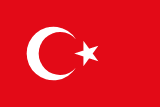
Turkey

Turkic
Turkey flag
Languages
Native
Turkish
88%
Secondary languages
Kurdish
12%
English
17%
Language Samples
Merhaba, nasılsın?
Hello, how are you?
İyiyim, teşekkürler.
I am very well, thanks.
Bir, iki, üç, dört, beş, altı, yedi, sekiz, dokuz, on.
One, two, three, four, five, six, seven, eight, nine, ten.
Linguistic History

Turkish is a member of the Oghuz branch of the Turkic language family and has been spoken in Anatolia since the Seljuk migrations of the 11th century. For centuries, the Ottoman state used Ottoman Turkish written in the Arabic script — a tradition maintained through the rise and fall of one of history's largest empires. In 1928, as part of Mustafa Kemal Atatürk's sweeping modernisation programme, the Arabic script was replaced by a newly designed Latin alphabet tailored to Turkish phonology. Literacy campaigns rapidly spread the new writing system, and within a generation the Ottoman script had passed out of everyday use. Modern Standard Turkish has also been systematically purged of Arabic and Persian loanwords since the 1930s, with the Turkish Language Association coining native replacements drawn from Old Turkic roots.

Similar Languages
Azerbaijani
85%
Turkmen
79%
Uzbek
73%
Kyrgyz
68%
Media
Hagia Sophia in Istanbul — built in 537 AD, it has served as a cathedral, mosque, museum, and mosque again, embodying the layers of civilisation that have shaped Turkish culture.
Photo: Arild Vågen · CC BY-SA 3.0
Did You Know
01
Turkish is an agglutinative language — suffixes are stacked onto a root to encode meaning, so a single word like 'Çekoslovakyalılaştıramadıklarımızdanmışsınızcasına' can express an entire English sentence.
02
The Latin alphabet adopted in 1928 includes letters not found in other Latin-script languages, such as ğ (soft g), ı (dotless i), ş, and ç, chosen to precisely represent Turkish sounds.
03
Turkish has no grammatical gender and uses vowel harmony — the vowels in suffixes must harmonise in quality with the vowels of the root word, giving the language a distinctive rhythmic sound.
Want to learn this language?
Start learning Turkish today
Learn with Lingua →