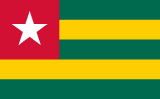
Togo is one of West Africa's smallest countries, sandwiched between Ghana and Benin, yet it contains a rich linguistic tapestry of around 40 languages. Ewe (Eʋegbe), a Gbe language closely related to Fon, is the dominant tongue of the southern coastal region — historically the most densely populated and economically active part of the country. Ewe-speaking communities also extend significantly into neighbouring Ghana's Volta Region, making the Ewe an important trans-border ethnic group. In the north, Kabiyé is the second major indigenous language and holds special political significance as the language of the late long-ruling president Gnassingbé Eyadéma and his family. Togo was first colonised by Germany (German Togoland, 1884–1914), then divided between France and Britain after World War I; the French sector became independent in 1960. French remains the official language, but Ewe and Kabiyé both serve as national languages with a degree of formal recognition. The capital Lomé, on the Atlantic coast, is predominantly Ewe-speaking.
