
Somalia

Cushitic · Afro-Asiatic
Somalia flag
Languages
Native
Somali
95%
Secondary languages
Arabic
15%
Language Samples
Nabad, sidee tahay?
Hello, how are you?
Waan fiicanahay, mahadsanid.
I am very well, thanks.
Kow, labo, saddex, afar, shan, lix, toddoba, siddeed, sagaal, toban.
One, two, three, four, five, six, seven, eight, nine, ten.
Linguistic History

Somali is a Cushitic language of the Afro-Asiatic family, closely related to Afar and Oromo, and has been spoken in the Horn of Africa for at least 2,500 years. Despite its ancient roots, Somali had no official writing system until 1972, when the government of President Siad Barre adopted a standardized Latin-script orthography, making it one of the last major world languages to be formally transcribed. Before that, Arabic script and several competing Latin and Osmanya-script proposals had been in use among scholars and communities. The swift adoption of the Latin alphabet was accompanied by a dramatic national literacy campaign. Arabic retains influence as a language of religion and trade, particularly along the coast where Somali merchants have interacted with the Arab world for centuries. Somali dialects are mutually intelligible and include Northern (Isaaq), Benaadir (coastal), and Maay, the latter showing some divergence.
Similar Languages
Afar
30%
Oromo
14%
Sidamo
12%
Media
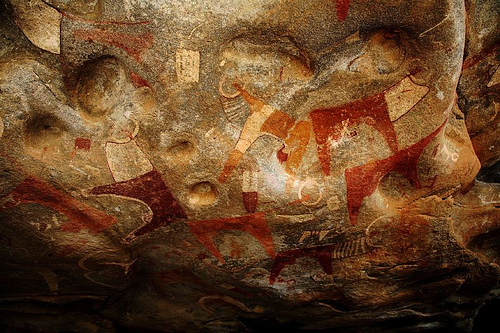
The Laas Geel cave paintings near Hargeisa date to 9,000–3,000 BCE — among the oldest rock art in the Horn of Africa.
Photo: Abdullah Geelah · CC BY-SA 3.0
Mogadishu, where Somali and Arabic have coexisted as languages of daily life and commerce for centuries.
Did You Know
01
Somali adopted its official Latin-script orthography in 1972 — one of the last major languages in the world to receive a standardized written form.
02
The Osmanya script, invented in the early 20th century specifically for Somali, is still used by enthusiasts and in some diaspora communities.
03
Somali has an exceptionally rich oral poetry tradition; poets (called 'gabayaa') hold great social prestige, and verbal dueling in verse is a respected art form.
Want to learn this language?
Start learning Somali today
Learn with Lingua →