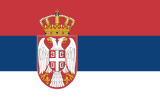
Languages
Native
Serbian
88%
Secondary languages
English
22%
Hungarian
13%
Language Samples
Здраво, kako си?
Zdravo, kako si?
Hello, how are you?
Добро сам, хвала.
Dobro sam, hvala.
I am well, thanks.
Један, два, три, четири, пет, шест, седам, осам, девет, десет.
Jedan, dva, tri, četiri, pet, šest, sedam, osam, devet, deset.
One, two, three, four, five, six, seven, eight, nine, ten.
Linguistic History
Serbian is a South Slavic language that, together with Croatian, Bosnian, and Montenegrin, forms the South Slavic dialect continuum historically called Serbo-Croatian. The medieval Serbian literary tradition used Church Slavonic, with Vuk Stefanović Karadžić reforming the Serbian Cyrillic alphabet in the early 19th century under the principle 'write as you speak, read as it is written'. Serbian is unique among Slavic languages in being fully digraphic — it has perfectly parallel Cyrillic and Latin alphabets and speakers switch between them freely. The Cyrillic script remains the official and more formal script, while Latin is widely used in everyday digital communication.
Similar Languages
Bosnian
93%
Croatian
90%
Macedonian
70%
Slovenian
60%
Media

Belgrade panorama as seen from Kalemegdan Fortress at the confluence of the Sava and Danube rivers.
Photo: Andrija12345678 · CC BY-SA 4.0
Did You Know
01
Serbian is the only European language in standard everyday use that employs two completely parallel scripts — Cyrillic and Latin — with full equivalence.
02
The Serbian language has a musical pitch accent system, meaning the same syllable can have two different tones that change a word's meaning entirely.
03
Nikola Tesla, who conducted his scientific work in English, was a native Serbian speaker born in the Serbian village of Smiljan (now in Croatia).