Burkina Faso

African · Niger-Congo
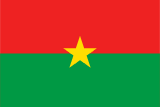
Burkina Faso flag
Languages
Native
Mooré (Mossi)
50%
Secondary languages
French
22%
Language Samples
Ne y windga, fo yaa kẽere?
Good morning, how did you sleep?
M yaa kẽere laafia, y'a to.
I slept in peace, thank you.
Ayi, ayibu, atan, anass, anu, aasiga, ayopoe, aniin, awɛn, piiga.
One, two, three, four, five, six, seven, eight, nine, ten.
Linguistic History

Burkina Faso, known as Upper Volta until its 1984 renaming by revolutionary leader Thomas Sankara, takes its new name from two languages: 'Burkina' (people of integrity / upright people) from Mooré, and 'Faso' (fatherland / land of the forefathers) from Dioula. Mooré, the language of the Mossi people, is spoken by roughly half the population and has been the dominant language of the country's central plateau since the Mossi kingdoms (Wagadugu and Yatenga) rose to prominence around the 11th–12th centuries. The Mossi states maintained political continuity for over 500 years and resisted both the Mali and Songhai empires. Dioula (Jula), a Mande trade language closely related to Bambara, serves as the principal commercial lingua franca especially in the west. French, introduced during French colonial rule as French Upper Volta (1919–1960), is the sole official language. Burkina Faso has roughly 70 indigenous languages in total. The country is among the world's least developed nations, and oral tradition in Mooré remains the primary vehicle of cultural transmission.

Similar Languages
Dagbani (Ghana)
55%
Frafra (Ghana)
60%
Media
The Grand Mosque of Ouagadougou, capital of Burkina Faso, in the heart of Mooré-speaking Mossi territory.
Photo: C. Hugues · CC BY-SA 2.0
Did You Know
01
The country's very name is bilingual: 'Burkina' comes from Mooré meaning 'upright people' and 'Faso' comes from Dioula (Bambara) meaning 'fatherland' — a deliberate linguistic union chosen by President Thomas Sankara in 1984 to represent the country's two main language communities.
02
Mooré uses a special noun class system where animate beings and certain inanimate objects are sorted into distinct classes that govern agreement across the entire sentence — similar in function to grammatical gender but with different categories.
03
The Mossi kingdom of Ouagadougou (Wogodogo) has been ruled by the Moro Naba (Great Chief) in an unbroken royal lineage for over 600 years; the Moro Naba ceremony is still performed every Friday morning in Mooré and draws hundreds of attendees.
Want to learn this language?
Start learning Mooré (Mossi) today
Learn with Lingua →